As we start the F. Scott Fitzgerald's "The Great Gatsby", we have been talking a lot about class, as it is a major component of the book. I figured I would just add to the discussion a little bit.
On Friday, we looked at a "class calculator" put up by the New York Times. This calculator basically says that class is calculated by occupation, education, income and wealth. However, we talked in class that maybe those aren't the only factors. For example, behavior may be a major component. If someone is wealthy but is a bad person or just acts not like one would expect a high-class person to act, would they still be considered high-class? I began to consider celebrities who act like this. They are clearly very wealthy and have a lot of influence, however the ones who act in completely inappropriate ways are still seen as high-class by many people.
There really is no one way to define class. It is really just a matter of opinion, because class is different to everyone. Ones perception of it is completely relative to where they grew up, how their childhood was, and how they have been influenced by other people.
Monday, May 2, 2011

Tuesday, April 12, 2011
...The Research Never Ends...
I am currently sitting in my American Studies class, staring at the first draft of an outline which I hope will turn into a decent junior theme. I know that the previous sentence sounded angry, and while this paper is stressful, it is actually incredibly interesting.
While researching my question of "why has rap entered the mainstream", I have realized that I must research much more than just the sales of rap. I must research why some people welcomed rap with open arms, and why some didn't. My paper is essentially split into two parts: why rap became popular in big cities, and why it became popular outside of the cities in suburbia. Through this, I have had to do a lot of research on how the cities were at the time, how safe they were, and what went on there. For the second part, I have to look at why people are attracted to a sense of danger, when they know that they can get away from it at any time. Clearly not what I expected.
So while I have to do more work than I initially thought, I must admit that I enjoy it. I have learned that the destruction of the Bronx and Harlem was due a man named Robert Moses, who wanted to make a more connected New York. Because he would bulldoze through houses to build his superhighways, people began to move out, and the streets became deserted and dangerous.
Yeah, that's not a lot, but that's what I've learned thus far since realizing I had to do all of this extra work. I'm reading two books ("Can't Stop Won't Stop" by Jeff Chang, and "The Big Payback" by Dan Charnas) as well as reading many scholarly articles and historical newspapers. Either way the story of how hip-hop became a major part of our culture is incredibly interesting, and I will be providing you with an update next week (hopefully I will have made more progress by then...)!
While researching my question of "why has rap entered the mainstream", I have realized that I must research much more than just the sales of rap. I must research why some people welcomed rap with open arms, and why some didn't. My paper is essentially split into two parts: why rap became popular in big cities, and why it became popular outside of the cities in suburbia. Through this, I have had to do a lot of research on how the cities were at the time, how safe they were, and what went on there. For the second part, I have to look at why people are attracted to a sense of danger, when they know that they can get away from it at any time. Clearly not what I expected.
So while I have to do more work than I initially thought, I must admit that I enjoy it. I have learned that the destruction of the Bronx and Harlem was due a man named Robert Moses, who wanted to make a more connected New York. Because he would bulldoze through houses to build his superhighways, people began to move out, and the streets became deserted and dangerous.
Yeah, that's not a lot, but that's what I've learned thus far since realizing I had to do all of this extra work. I'm reading two books ("Can't Stop Won't Stop" by Jeff Chang, and "The Big Payback" by Dan Charnas) as well as reading many scholarly articles and historical newspapers. Either way the story of how hip-hop became a major part of our culture is incredibly interesting, and I will be providing you with an update next week (hopefully I will have made more progress by then...)!
Sunday, March 20, 2011
Choosing a Theme
This week in American Studies we started working on a little project known as Junior Theme. This paper will take up much of fourth quarter and is a major part of our grade, thus it's probably a good idea that we choose a topic that we're really interested in. Personally, I knew that the general topic wouldn't be very hard to choose. Two things that I am really interested in are music and technology, thus I quickly narrowed my search for a question down to these two topics.
From there it got difficult. I had no idea what my "why" question should be. I thought that I could do something about music technology, electronic music, rock music, Apple computers and how they're taking over the world, but I just couldn't think of a question that would not only be interesting to me but also had a history in America. After thinking some more, I finally came up with one topic that is truly one of the most controversial topics in pop culture right now: hip-hop music.
Portraying themes of violence, sex and excess, hip-hop was the perfect topic. It had its roots in race music, such as jazz, blues and R&B, yet was a modern topic that has two very distinct sides to the argument of whether it is healthy for our community or not. Because of this argument, it led me to the perfect why question: Why does hip-hop influence people's perceptions about African-American culture?
While it was a difficult process, I found a topic that I am really interested in and I cannot wait to research it further.
UPDATE: Turns out my teachers didn't like that question, they wanted something more honed in and focused, which makes sense. I have now changed my question to "why did hip-hop become part of mainstream music?" This will be very interesting to research and I am very excited to write this paper.
From there it got difficult. I had no idea what my "why" question should be. I thought that I could do something about music technology, electronic music, rock music, Apple computers and how they're taking over the world, but I just couldn't think of a question that would not only be interesting to me but also had a history in America. After thinking some more, I finally came up with one topic that is truly one of the most controversial topics in pop culture right now: hip-hop music.
Portraying themes of violence, sex and excess, hip-hop was the perfect topic. It had its roots in race music, such as jazz, blues and R&B, yet was a modern topic that has two very distinct sides to the argument of whether it is healthy for our community or not. Because of this argument, it led me to the perfect why question: Why does hip-hop influence people's perceptions about African-American culture?
While it was a difficult process, I found a topic that I am really interested in and I cannot wait to research it further.
UPDATE: Turns out my teachers didn't like that question, they wanted something more honed in and focused, which makes sense. I have now changed my question to "why did hip-hop become part of mainstream music?" This will be very interesting to research and I am very excited to write this paper.
Sunday, March 6, 2011
Why is it Only the Drama?
This week in American Studies, we have been talking about racial tokenism, and specifically how it applied to major network dramas. Our teachers have even said that tokenism is only present in network dramas, because other types of shows (sitcoms, reality shows), follow different rules.
I began to think of what those different rules were. I mean, all types of shows are for the purpose of entertainment, not just network dramas, so shouldn't they all follow basically the same rules? Well, in the same way that we looked at cast pictures of network dramas, I looked at a cast picture of the ABC sitcom "Modern Family".
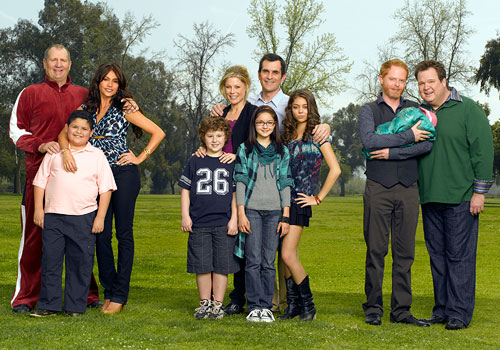
This clearly would never be the cast picture for a network drama. In the photo there is a gay couple, a family where the husband is twice the age of the wife (and the wife is hispanic), and what we would call a "traditional" family. However, when one watches the show, it really pokes fun at all of these topics. It pokes fun at the fact that the families are different or dysfunctional, and that one of the women is latino.
We also looked at the NBC sitcom 30 Rock, which does the exact same thing. They make fun of tokenism and all of the elements that you cannot just make a joke at in a network drama.
So is that the answer? The difference between the two and tokenism is that one can make fun of it and the other one can't? I am not sure but it is a very interesting subject.
Sunday, February 20, 2011
The Future is RockMelt
A major theme in AIS this year is the media, and how it affects our lives. We all have Facebooks, some of us may have Twitters, some of us blog regularly, or follow blogs and other feeds, however we usually have to make at least some sort of effort to check them - whether it be physically going to the web page or using the app on your phone.
Well, not anymore. I recently started using a web browser, built off of the Google Chrome developer channel called RockMelt, and it has completely changed how I follow websites. On the left side of my browser, I have all of my news feeds: Facebook, Twitter, I even have multiple blogs and a YouTube app. On the right side of my screen I can update my status on either of these social networking sites and I can quickly see which of my Facebook friends are online and chat with them. I can do ALL of this without closing out of my current webpage. Plus, it alerts me when something new is added to my feed, so I always know what is going on.
It's overwhelming, weird, and scary, but it's so awesome. It is still in beta, so it's not perfect, but this is where I see social networking going. Even just staring at this blog post, everything is right in front of me. This is just an example of how the world is becoming a truly "globalized society". I am connected to everything, and everything is connected to me.
Well, not anymore. I recently started using a web browser, built off of the Google Chrome developer channel called RockMelt, and it has completely changed how I follow websites. On the left side of my browser, I have all of my news feeds: Facebook, Twitter, I even have multiple blogs and a YouTube app. On the right side of my screen I can update my status on either of these social networking sites and I can quickly see which of my Facebook friends are online and chat with them. I can do ALL of this without closing out of my current webpage. Plus, it alerts me when something new is added to my feed, so I always know what is going on.
It's overwhelming, weird, and scary, but it's so awesome. It is still in beta, so it's not perfect, but this is where I see social networking going. Even just staring at this blog post, everything is right in front of me. This is just an example of how the world is becoming a truly "globalized society". I am connected to everything, and everything is connected to me.
Sunday, February 13, 2011
What are the Grammy's Leaving Out?
So, the 53rd annual Grammy awards are tonight. I am very excited to watch for a few reasons. First, I enjoy all of the performances and collaborations that occur throughout the night, I really want to see who wins best alternative rock album, and I want to know who isn't going to be televised.
In case you didn't know, many of the awards are not televised. This is because there simply isn't enough time in the show to televise them, and that not as many people would be interested in "best engineered album" as opposed to "best new artist".
I did a little bit of research on last year's winners that weren't televised, and I found some pretty interesting things. We all know that most of the show is based around pop music, so it wasn't much of a surprise to me that many of the non-televised awards were for best albums in rock, jazz, bluegrass, and gospel. However, I am not completely sure why this is so. Throughout the year in AIS, we have been discussing the media's "secret messages" and how everything has some sort of implication or meaning. I wonder if it means something that people are assumed to not care about categories like "best traditional folk album" or "best historical album", in the same sense that MTV only plays music by Lady Gaga, Justin Bieber and Ke$ha. It makes me wonder if this censorship is purposefully done.
So when I watch the Grammy's tonight, I know that I won't get to see Wolfgang Gartner win an award for best remix (how many of you guys actually knew he was nominated?), and I won't get to see Deadmau5, or any major electronic producer, even nominated for best electronic album (how does that happen?!?!). It seems as if the Grammy's are sending us secret messages.
In case you didn't know, many of the awards are not televised. This is because there simply isn't enough time in the show to televise them, and that not as many people would be interested in "best engineered album" as opposed to "best new artist".
I did a little bit of research on last year's winners that weren't televised, and I found some pretty interesting things. We all know that most of the show is based around pop music, so it wasn't much of a surprise to me that many of the non-televised awards were for best albums in rock, jazz, bluegrass, and gospel. However, I am not completely sure why this is so. Throughout the year in AIS, we have been discussing the media's "secret messages" and how everything has some sort of implication or meaning. I wonder if it means something that people are assumed to not care about categories like "best traditional folk album" or "best historical album", in the same sense that MTV only plays music by Lady Gaga, Justin Bieber and Ke$ha. It makes me wonder if this censorship is purposefully done.
So when I watch the Grammy's tonight, I know that I won't get to see Wolfgang Gartner win an award for best remix (how many of you guys actually knew he was nominated?), and I won't get to see Deadmau5, or any major electronic producer, even nominated for best electronic album (how does that happen?!?!). It seems as if the Grammy's are sending us secret messages.
Sunday, February 6, 2011
Our Thirst For Knowledge
I just read this morning that two of NASA's STEREO probes have finished revolving around their respective halves of the sun, and humans will now have a complete, 360 degree view of the sun. You can read the full article here.
The first thing I thought of when I saw this article was how humans' thirst for knowledge is never ending. We are always trying to make everything predictable so that nothing is a surprise anymore (this is even mentioned in the article). Thus, I related this to Mark Twain's Adventures of Huckleberry Finn.
Huck used to like surprises and anything out of ordinary when he was living with the Widow and Miss Watson. He got bored with the daily routine and wanted something more, which is why he would have adventures with Tom. However, as the book progresses and Huck sees the world as it really is by traveling on his raft, Huck begins to dislike these surprises. Instead, he wants to know when things are happening, and at times even regrets getting into this situation in the first place. He hates that fact that he will not know what is going to happen to Jim when he is left alone, or even what they will do if the raft is lost. I guess this is a way of Mark Twain commenting on human nature. Humans are naturally curious, however, as we discover the dangers of the world, we begin to want to foresee them more and more. This is what NASA has done.
The first thing I thought of when I saw this article was how humans' thirst for knowledge is never ending. We are always trying to make everything predictable so that nothing is a surprise anymore (this is even mentioned in the article). Thus, I related this to Mark Twain's Adventures of Huckleberry Finn.
Huck used to like surprises and anything out of ordinary when he was living with the Widow and Miss Watson. He got bored with the daily routine and wanted something more, which is why he would have adventures with Tom. However, as the book progresses and Huck sees the world as it really is by traveling on his raft, Huck begins to dislike these surprises. Instead, he wants to know when things are happening, and at times even regrets getting into this situation in the first place. He hates that fact that he will not know what is going to happen to Jim when he is left alone, or even what they will do if the raft is lost. I guess this is a way of Mark Twain commenting on human nature. Humans are naturally curious, however, as we discover the dangers of the world, we begin to want to foresee them more and more. This is what NASA has done.
Subscribe to:
Posts (Atom)